What is Optionality and Why Does it Mater?
What is Optionality and why could it be the most business concept ever! We’ve all heard the expression, Change Creates Opportunity and with NO change there are No opportunities. So Nothing new here, but in a post pandemic AI world, the ampunt of data we have access to is more than ever, the technology that we have now, has compressed decades of change into right NOW. This rapid change, is taking…

How much room does your strategy leave for the unexpected? In a business environment shaped by rapid technological change and the disruption of COVID-19, that question has become difficult to ignore. A plan may look convincing today, but its value depends partly on what happens when circumstances change.
Optionality is the ability to keep more than one future path open. For leaders, it means building a business that can respond to new information, pursue opportunities and change course without the cost of doing so becoming catastrophic. It is a useful way to think about strategy, and an equally useful way to think about how our teams make decisions under pressure.
Where optionality comes from
The idea has its roots in finance. An option gives its holder the right, but not the obligation, to take an action in the future, such as buying or selling an asset at a set price. Its value comes from that flexibility. You can act when the conditions are favourable and choose not to when they aren’t.
Nassim Nicholas Taleb describes optionality as “the property of asymmetric upside (preferably unlimited) with correspondingly limited downside”. A purchased stock option illustrates the idea: its value can rise substantially, while the buyer’s loss is limited to the premium paid. Venture capital follows a similar logic. A firm can lose its investment in a particular startup, but a successful investment may return 100 times that amount. [1]
Taleb helped bring this thinking into a wider conversation about strategy and uncertainty through books including The Black Swan and Antifragile. His argument is that we should give ourselves more exposure to positive surprises while limiting the damage from negative ones. With enough useful options, we don’t have to predict every outcome correctly. We need to avoid decisions that unnecessarily expose us to harm, recognise favourable outcomes and be able to act when they appear. [1]
That is the logic behind a portfolio of small bets, exploratory projects and alternative strategies. Trial and error gives us information we couldn’t have had at the beginning, provided we remain free to change direction as we learn. Taleb’s description of “not getting stuck” captures something important here. [2]
The real options approach to corporate strategy, which emerged in the 1990s and 2000s, applied this idea to investments such as research and development, exploratory acquisitions and entry into emerging markets. An investment could be valuable because it created future choices, even before it delivered an immediate return.
Optionality has since influenced career planning and broader life decisions as well as business strategy. The underlying question stays much the same: how can we give ourselves worthwhile alternatives, and retain the freedom to choose between them when we know more?
Why optionality matters now
The disruption of COVID-19 made the value of adaptability much harder to overlook. Technological acceleration has kept that pressure on. Leaders are dealing with an environment in which customer needs, operating conditions and competitive possibilities can change while a strategy is still being put into practice.
Keeping useful options open helps a business withstand shocks and respond to the opportunities that disruption creates. Deloitte’s work on digital acceleration and HBR’s discussion of adaptability both place flexibility at the centre of this challenge. The question for leaders is how to build that flexibility into the organisation before it is urgently needed. [3, 4, 5]
The business case for keeping options open
Research on organisational agility links adaptability with stronger financial performance, faster innovation, better customer satisfaction and more engaged employees. The McKinsey studies cited here examine the relationship between agility and business performance, while the wider research considers its contribution to resilience. [6, 7, 8]
These outcomes matter because a business needs to respond in more than one direction. It must be able to withstand a setback, but also move when a promising opportunity appears. A rigid strategy can make both harder. The case for optionality is that retaining viable alternatives gives a company more ways to respond, rather than leaving everything dependent on one set of assumptions proving correct.
The challenge is that the behaviours that preserve those choices don’t always come naturally. Even teams that understand the value of adaptability can close off options surprisingly quickly.
Why teams close off their options
We tend to seek agreement, return to familiar solutions and defend decisions we have already made. Groupthink can create alignment before alternatives have been properly considered. Status quo bias makes an established approach feel safer, while sunk costs encourage us to keep investing in a choice because we have already put so much into it. [9]
Organisational structures can reinforce those habits. Silos make it harder to bring different perspectives together, and bureaucratic planning can make changing course feel like a failure of the original plan. Under pressure, a team may become even more attached to the first answer that offers some certainty.
These are recognisable problems, which means leaders can work on them. Diversity of thought, rapid experimentation and flexible planning all help teams keep alternatives in view. The harder task is making those behaviours available when time is short and the pressure is real. That takes practice as well as understanding.
Learning to adapt under pressure
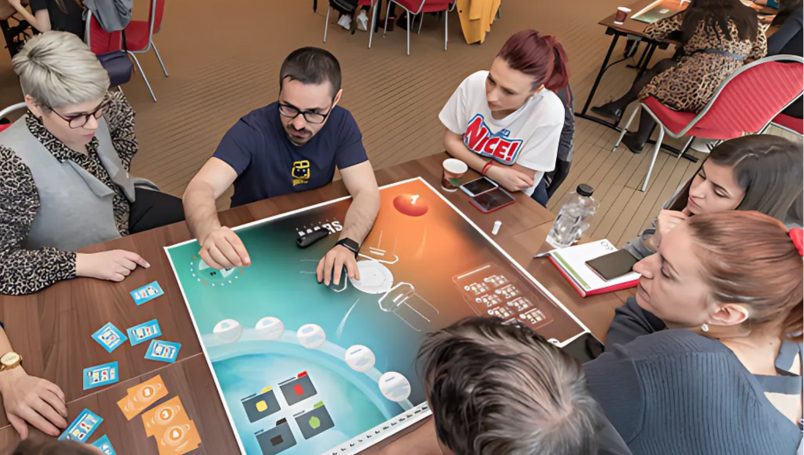
Experiential learning gives teams a way to practise these decisions together. A well-designed simulation introduces time pressure, ambiguous information and changing conditions, then asks people to work towards an outcome. The team has to experience uncertainty and make decisions within it.
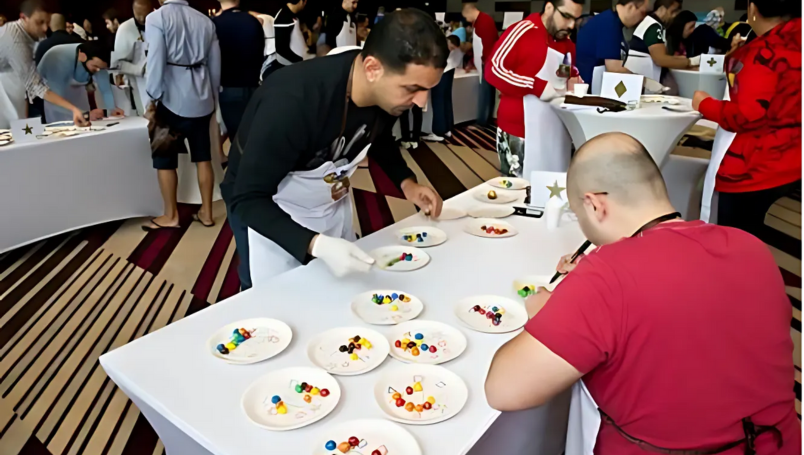
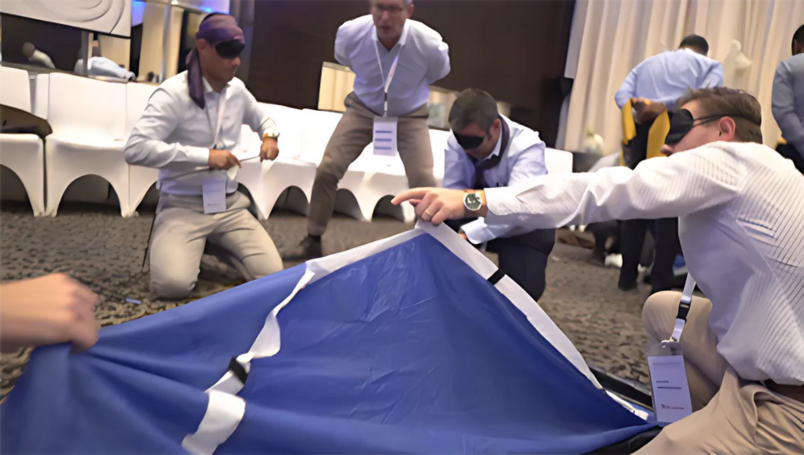
Turnaround’s outcome-driven team experiences use this approach. As the organisation puts it: “No blindfolds, no trust falls. Just business pressure, simulated safely.” One participant described “working under pressure with not much clarity” and said the experience “completely replicates how the world works”. The aim is to let teams practise adaptable thinking in a setting where mistakes can become useful learning. [11]
Keeping another route open
A change in a simulation can expose how dependent a team has become on its first idea. If that approach stops working, people have to consider what else is possible. Keeping Plan B and Plan C alive becomes a practical advantage rather than an abstract principle.
One participant in Turnaround’s On Shifting Sands simulation reflected: “It brought to light that we need to get creative instead of sticking with the same solutions.” Added constraints forced the team to change course when its usual approach failed. The experience made visible a tendency that can be harder to recognise in everyday work: continuing with familiar solutions even when the evidence calls for something different. [11]
Turnaround’s description, “Pressure can make some panic – we teach you how to pivot”, gets to the purpose of the exercise. The team experiences the value of holding alternatives open, then has a concrete example to draw on when similar behaviour is needed at work. [11]
Turning the experience into useful learning
The debrief is an important part of the process. What did we learn about our decision-making? When did we overlook an option that could have helped? How could we bring more than one perspective into a similar situation at work? Those questions connect the simulation with the decisions people will make afterwards.
One participant described it as “one of those awareness moments… like a great song, it reminds you what you need to do in the workplace”. That is the value of an experience people can remember and revisit when a real challenge brings the same habits to the surface. [11]
The experience also needs to fit the organisation. One team may struggle with silos, while another may be reluctant to experiment because people fear failure. A participant’s comment about Turnaround’s preparation captures why this matters: “They took the time to find out what we were about… and made sure the points were aligned.” Tailoring the simulation gives facilitators a way to focus on the behaviours that the team actually needs to develop. [11]
Practising before the stakes are real
Simulations also give teams a way to work with pressure before customers or revenue are at risk. They can reveal where communication breaks down, whose input is overlooked and how people respond when the situation becomes unclear. The aim is to help the team maintain clarity, communication and openness to new ideas when it would be easier to retreat into familiar habits.
The comparison with a flight simulator is useful. Pilots practise difficult situations so they can draw on that experience when it matters. A business simulation gives a team a similar opportunity to practise changing course, considering alternatives and coordinating under pressure. It can be delivered by a provider such as Turnaround or through internally developed scenario exercises. [11, 12]
Learning by doing makes the value of optionality tangible. People can see what happens when they close down a discussion too quickly or cling to an approach that no longer fits. They can also experience what becomes possible when they remain open to another route.
Making optionality part of everyday work
Simulations can help people recognise their habits, but leaders need to reinforce that learning in everyday decisions. A team is unlikely to keep exploring alternatives if the normal response to a different view is impatience or criticism.
Invite different perspectives
A 2025 PwC Pulse Survey found that 58% of CEOs were changing their decision-making process by actively gathering diverse perspectives from their team and encouraging internal debate. Half of those CEOs also said they were inviting outside challengers to question their strategies. [10]
That support from the top matters. It gives people permission to question an assumption or offer another route without treating disagreement as disloyalty. Leaders still have to make decisions, but they can do so after hearing a wider range of views and considering more than one option. PwC describes navigating disruption as requiring bold, informed action. Gathering different perspectives helps make that action better informed. [10]
Reinforce the behaviour you want
Consistency is essential. If we say we value optionality and then punish someone for raising a contrarian idea that doesn’t work out, the team will learn from the response rather than the message. Recognition, decision processes and leaders’ own behaviour need to support the same expectation.
That can include recognising teams that explore multiple solutions, making room for alternatives in planning templates and meetings, and using scenario planning to consider how circumstances might change. Continuous learning and experimentation help people update their choices as new information arrives. Over time, considering alternatives becomes part of how the business works, from the leadership team to the front line.
A more adaptable way to lead
Optionality gives leaders a practical way to think about a future they cannot fully predict. It encourages us to create room for learning and change in the plans we make today, and to prepare teams with several viable approaches rather than expecting one plan to cover every possibility.
The questions are straightforward. Where are we closing off alternatives too early? Can our team change course when the evidence changes? If a new competitor or technology appeared tomorrow, would our current choices leave us room to respond?
A Turnaround participant summed up one lesson as “Maintaining composure and adapting in frustration” and the realisation that “alignment beats frustration”. A shared commitment to staying adaptable helps a team move beyond frustration and act together. That is what makes optionality useful: people understand the direction, while remaining willing and able to find another way forward. [11]
Sources
1. 25iq. Taleb on optionality and asymmetric upside; Venture capital and investing; Recognising favourable outcomes.
2. Goodreads. Nassim Nicholas Taleb on trial and error and keeping options open.
3. Deloitte. Digital acceleration in a changing world; Disruption and resilience; Leaders’ expectations.
4. Harvard Business Review. Adaptability The New Competitive Advantage.
5. Trinity. Operational Agility in 2021; Adaptation during the pandemic. Harvard Business Review Analytic Services findings on business-model changes due to COVID-19 (91%).
6. McKinsey. How to create an agile organization. Global survey on agility and performance.
7. McKinsey. The impact of agility How to shape your organization to compete. Figures cited: 30% efficiency gain and 5–10 times speed.
8. Vorecol. Key indicators of successful adaptability to change in the workplace; Financial performance; Adaptability and outcomes. An aggregation of McKinsey, SHRM and Gartner statistics.
9. Chief Executive. How to Fight Groupthink; Techniques for encouraging debate; Decisions under uncertainty. Debate and decision outcomes (2.3 times success).
10. PwC. 2025 Pulse Survey on CEOs seeking diverse perspectives; Outside challengers; Bold informed action. Includes the 58% finding on gathering diverse views and encouraging internal debate.
11. Turnaround. Simulation testimonials and positioning, including Before Mars, On Shifting Sands and Chocolate Factory.
12. Aptara. Simulation Based Learning A Game Changer for Developing Corporate Leaders; Benefits and risk.