The SMEs Are Coming
AI is no longer just a tool for improving efficiency — it is fundamentally changing how quickly businesses can adapt and evolve. While many large organizations are layering AI onto complex legacy systems, smaller and more agile businesses are using AI to rapidly experiment, rebuild, and innovate at speeds that were previously impossible. The real competitive advantage is no longer scale alone, but…
For the last two and a half years, we’ve been building a technology platform inside our business. Like many companies, we approached it traditionally. Then AI changed what was possible for us in very practical ways.
Over the last several months, I’ve rebuilt major parts of our business using AI-assisted development and vibe coding approaches. As a non-technical founder, I’ve suddenly been able to create workflows, integrations and analytics capabilities that previously required specialist teams and significant development time. What once took months now takes days, and what once took days now takes hours. That experience has forced me to confront an uncomfortable question.
What happens when small businesses can evolve faster than large corporations can transform?
I don’t think this is just another technology shift. I think it’s a revolution in organizational agility, and I believe many large organizations are underestimating the scale of the threat.
The Dangerous Illusion of AI Transformation
Right now, many corporates appear to be embracing AI, and on the surface it looks impressive. In many cases, though, these are still fringe activations sitting on top of legacy infrastructure. AI is being wrapped around systems that were never designed for this level of speed and adaptability.
Imagine a huge tangled ball of legacy processes, systems, approvals, governance structures and technical debt, with sleek AI interfaces plugged into the outside. The experience may improve and the interface may become more intelligent, but the organizational core often remains unchanged. That’s the real danger, because AI is compressing the time it takes for businesses to evolve, as well as improving their efficiency.
The Problem With Slow Transformation
Historically, large organizations had the advantage, and transformation projects taking two or three years were considered normal. AI doesn’t evolve on enterprise timelines, though. If a transformation project takes two years, there is now a genuine possibility that the technology landscape will fundamentally shift before the project is even complete.
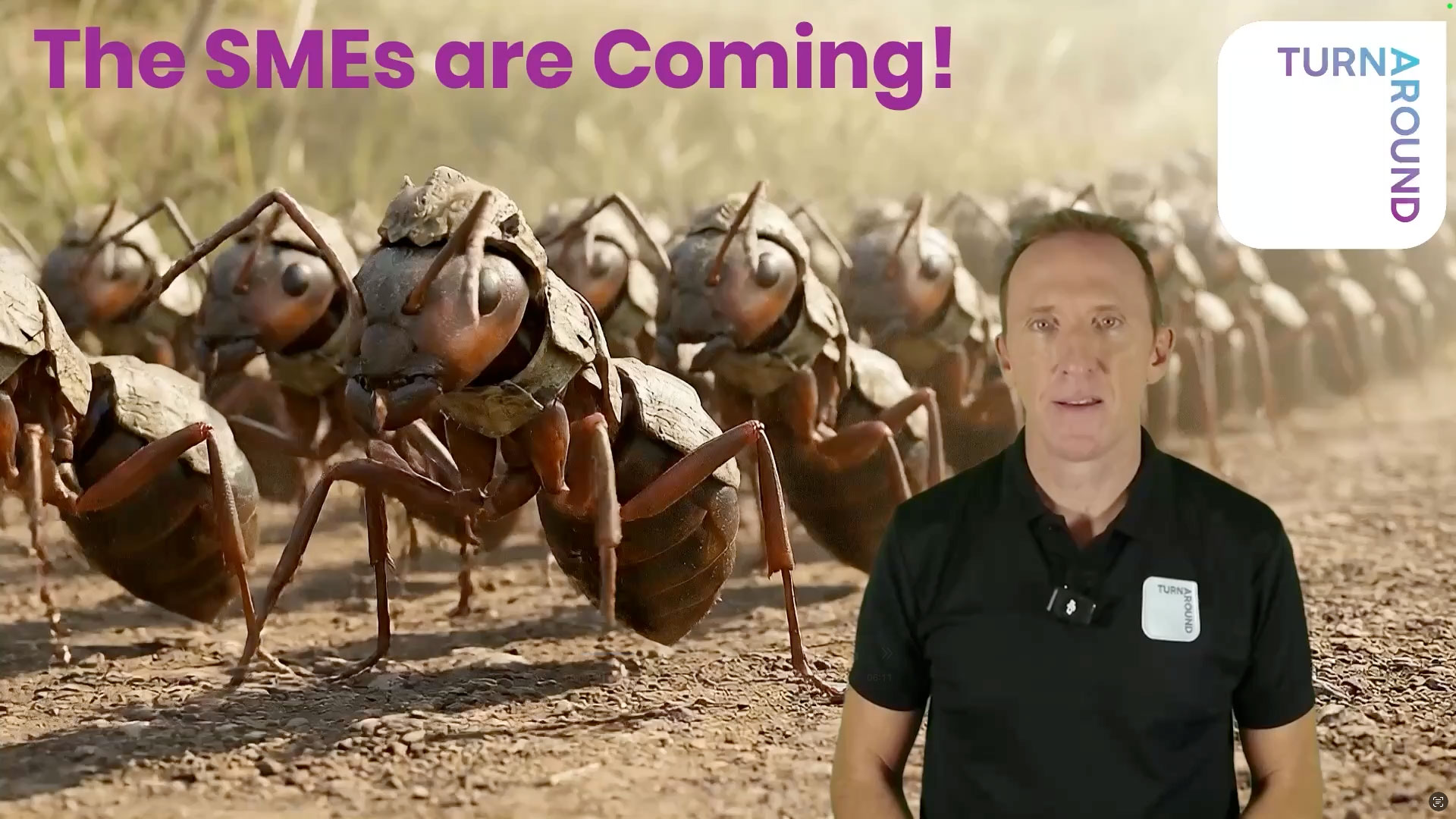
I see this as a structural challenge rather than a criticism of corporates. Large organizations are often trying to evolve while carrying decades of accumulated complexity in their systems, processes and governance. Meanwhile, SMEs are increasingly operating like speedboats alongside cargo ships, and AI dramatically amplifies that advantage.
This Is Not About Coding
The biggest misconception is that this is simply a software conversation. What matters is how quickly a company can adapt and evolve: its organizational metabolism. AI is exposing the gap faster than previous technological shifts. For years, many organizations optimized for stability, but the environment now increasingly rewards adaptability. That is a profound change in what it takes to compete.
The SMEs Are No Longer Playing the Same Game
Historically, capabilities such as the workflows, integrations and analytics I’ve been building were harder for SMEs to access, because they required specialist teams and significant development time. AI is rapidly lowering those barriers, allowing small, agile companies to access those capabilities at remarkable speed.
The implications are enormous. Disruption no longer necessarily requires massive capital investment when a business can adapt and evolve so much faster. The companies that move fastest may no longer be the largest. They may simply be the ones least held back by their own structures.
Fight, Flight or Freeze
When organizations face uncertainty, they often fall into one of three responses: fight, flight or freeze. How they respond matters when the pace of change is accelerating.
Freeze
Freezing is perhaps the most dangerous response right now. It can mean waiting and observing, hoping the market settles, or running small pilots while protecting the status quo. Standing still is no longer neutral, because in an AI-driven environment, slow adaptation can become active decline.
Flight
Some organizations will respond defensively and retreat from change. That rarely protects them from disruption and usually accelerates it.
Fight
The fight that matters is against organizational inertia. It means being willing to rethink the business from the inside out, rather than treating AI itself as the enemy. The organizations that thrive may not be the ones with the biggest AI budgets, but those most willing to make that deeper change.
This Is Bigger Than Technology
I believe this is fundamentally a story about behaviour, leadership and culture. AI is forcing organizations to confront difficult questions about how they operate and how willing they are to change. Those are organizational questions, and the answers may define which companies survive the next decade.
Final Thought
The greatest risk today may be believing that small, surface-level AI improvements are enough while the core of the organization remains structurally resistant to change. Adopting AI is only part of the challenge. Somewhere right now, a small, agile business is rebuilding itself at a speed that would have been impossible two years ago, and it isn’t waiting for permission.